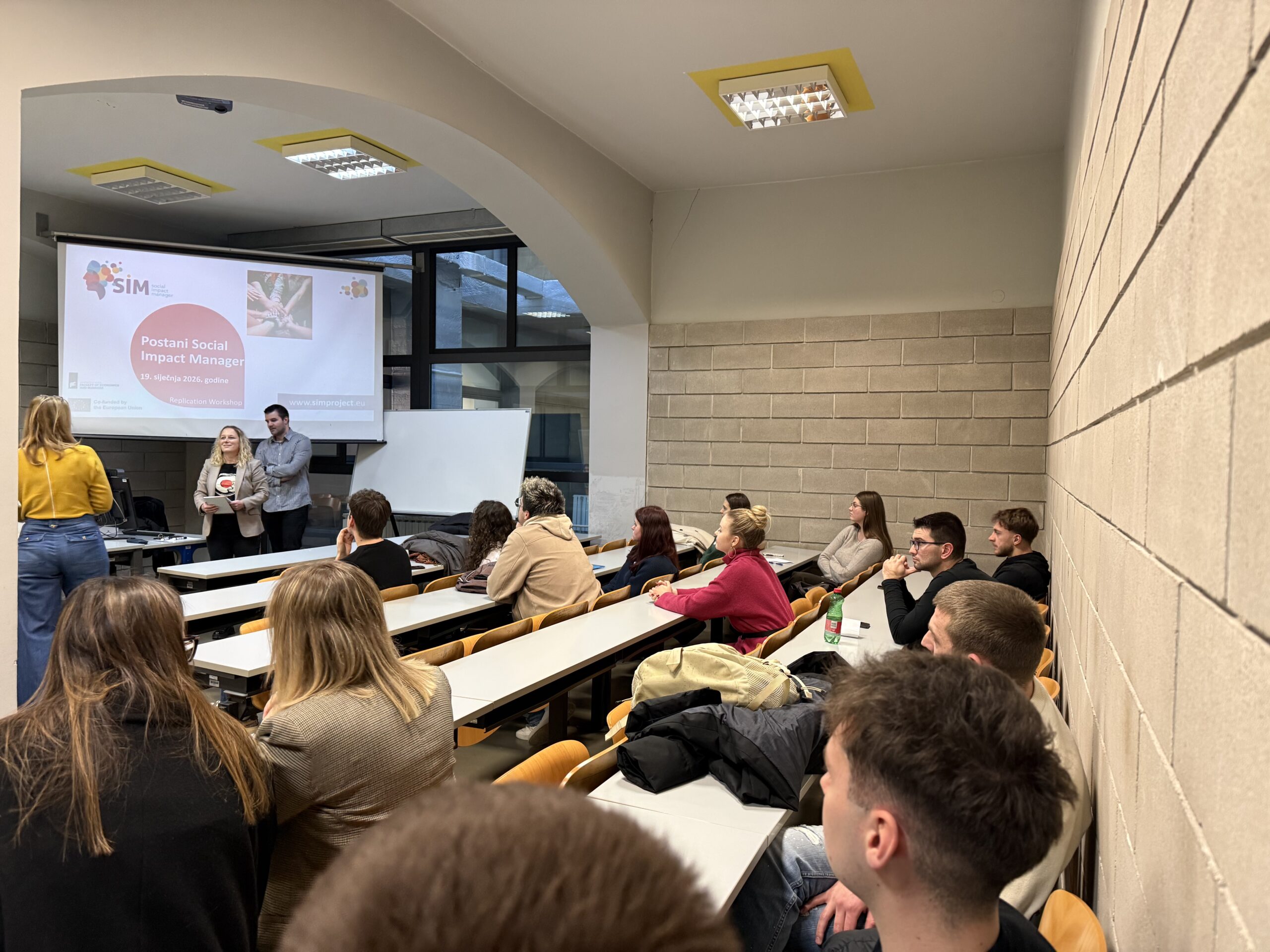
On 19 January 2026, the University of Rijeka, Faculty of Economics and Business (EFRI), Croatia, hosted a dynamic two-hour, in-person Social Impact Manager (SIM) Replication Workshop, bringing together 34 participants to explore the growing importance of social impact management in today’s economy.
The workshop served as both a reflection on the achievements of the SIM project and a forward-looking platform to inspire future social impact professionals.
The programme began with welcoming speeches from the organisers, setting the tone for an interactive and forward-thinking session. Participants were introduced to the key achievements of the SIM project, its goals and milestones, as well as future opportunities and perspectives for further development
Current SIM participants then shared their personal experiences, offering authentic insights into the programme’s value and encouraging attendees to take part in future editions. Their testimonials highlighted how the SIM initiative supports both professional growth and meaningful societal contribution.
Why Social Impact Matters
The central part of the workshop focused on an open discussion between organisers and participants about the necessity and importance of social impact initiatives in improving the economy and society. The dialogue revealed strong awareness among participants of the role that structured impact strategies, ESG integration, and stakeholder collaboration play in building resilient and inclusive communities.
Throughout the workshop, attendees gained insight into core Social Impact Manager areas, including:
- ESG principles (Environmental, Social, Governance)
- Stakeholder engagement strategies
- Impact measurement and evaluation
- Strategic thinking for sustainable value creation
Importantly, participants explored how these competencies are increasingly relevant for future career development, particularly in a rapidly evolving labour market that values sustainability and responsible leadership.
Mini Impact Lab: Learning by Doing
A highlight of the session was the Mini Impact Lab, an interactive, practice-oriented activity designed to simulate the real-life role of a Social Impact Manager. Working in teams, participants identified real social challenges and mapped key stakeholders and available resources. The exercise demonstrated collaboration, creativity, and critical thinking. Continuous mentor feedback and peer exchange ensured that the learning experience was both reflective and action-oriented.
By stepping into the role of a Social Impact Manager, participants gained a firsthand understanding of how structured methodologies can translate social ambition into measurable impact.
Some Key Findings and Participant Feedback
- Strong Interest in Social Impact Topics
Participants demonstrated a high level of interest in social inclusion initiatives and impact-driven projects.
- Foundational Knowledge Base
While most attendees possessed basic knowledge of social impact concepts, there remains significant room for deeper capacity building.
- Curricular Representation
Social impact themes are present within university curricula; however, structured and comprehensive programmes dedicated to the topic remain limited.
- Clear Demand for More Programmes
Despite strong awareness of the importance of social impact initiatives, there is a noticeable shortage of educational formats that affirm and expand these themes.
- Motivation to Upskill
Participants showed a strong willingness to further develop their knowledge and competencies in social impact management.
- Structural Constraints
Time limitations and competing academic or professional obligations often restrict participation in long-term educational programmes.
Overall, the findings confirm a clear demand for accessible, flexible, and practice-oriented learning formats that better accommodate students and professionals while strengthening the integration of social impact topics into formal education systems.
Looking Ahead: Expanding the SIM Community
The Replication Workshop at EFRI confirmed both enthusiasm and readiness for deeper engagement in social impact education.
To build on this, the University of Rijeka, Faculty of Economics and Business, plans to conduct additional workshops before the conclusion of the SIM programme. These upcoming sessions will focus on recruiting new potential participants, expanding outreach, and strengthening the SIM community for future editions. By continuing to invest in practice-oriented, collaborative learning formats, EFRI reaffirms its commitment to shaping the next generation of Social Impact Managers.