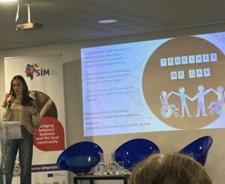
 The first generation of Social Impact Managers, a new European career pathway that blends business, ethics and social responsibility, gathered with project partners on November 4th, 2025, at the House of Europe | Maison de l’Europe in Paris, warmly hosted by the University of Paris 1 Panthéon-Sorbonne.
The day opened with two thought-provoking masterclasses and roundtables. Prof. Maryline Filippi from BSA and INRAE Paris Saclay spoke on Beyond CSR: Defining and Operationalising Territorial Corporate Responsibility (TCR), showing how enterprises can anchor their social responsibility in local partnerships and regional development. Muriel Noureau, Co-founder of Ezytail, followed with When Social and Local Responsibility Drive Growth, sharing a powerful account of how businesses can thrive by keeping people and purpose at their centre.
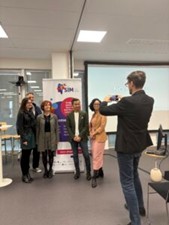 In the afternoon, seven cooperation projects were presented by graduates who had completed the SIM national training in their own countries. Uniquely, each project was shaped through collaboration between learners, companies, and community partners, and each tackled a different challenge, be that personal or corporate. Some projects are up and running while others are at an exploratory stage. All shared the same intention to connect people, business and community for lasting social impact.
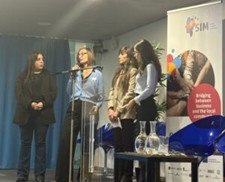 Among them were StartHer from Italy, tackling the challenge of opening access to credit for women in business, and VitaWin from France, which is building stronger bridges between schools and local SMEs. From Greece, the Donation Network showed how logistics expertise could improve national donation systems, while Early Detection for Brighter Vision from Croatia presented a social impact initiative focused on glaucoma prevention. Growing Together from Italy measured the community value of the Orto 3 agriculture project, Be2cation and KIY from Austria explored the use of artificial intelligence in learning and youth work, and Life Cycle, Cycle of Opportunities from Greece demonstrated how circular economy practices can build inclusion and green skills.
With such creativity in the room, it is no surprise that there was an electric atmosphere of curiosity and collaboration. Tough questions from educators, enterprises and policymakers spanned theory, practice and applicability for each business model, but every presenter rose to the challenge with confidence and clarity.
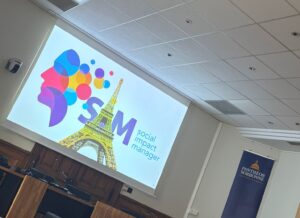 Day 2 of the SIM International School took place at the University of Paris 1 Panthéon Sorbonne, 12 place du Panthéon, 75005 Paris, in surroundings steeped in academic tradition and civic purpose. The University has stood for centuries as a place where scholarship meets public life, where ideas are tested through dialogue and where learning is inseparable from social responsibility. With its view across the Panthéon, the venue offered the perfect backdrop for another day of insight, exchange and collaboration.
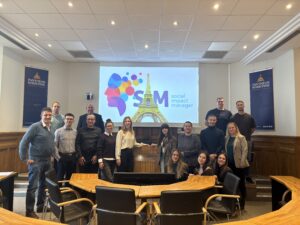 The morning opened with a new series of project pitches from the second group of SIM participants, each presenting business models developed through the national training programmes. The range of ideas once again showed the strength and adaptability of the Social Impact Manager profile.
From France, Recognising Commitment, Amplifying Impact: The TE and IP Label examined how recognition systems can reward authentic social engagement. From Italy, Aligning Values with Action explored how Epson is embedding diversity, equity and inclusion into its corporate strategy. From Greece, the Sustainability of Castle Towns and Traditional Settlements addressed the challenges of climate adaptation and heritage preservation. From Croatia, Trust Your Eyes continued the focus on eye health and community well-being. A second French initiative, Turning Unemployment into Opportunity, showed how local partnerships can mobilise networks for inclusive employment. From Austria, FEM Med introduced new approaches to strengthening collaboration between medical professionals and social impact projects.
The afternoon featured two thought-provoking roundtables that connected corporate practice with territorial innovation.
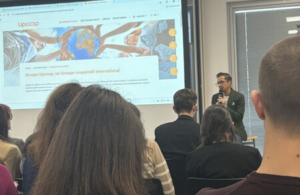 Up Coop is a key part of social welfare and economic life in their operating countries, with offerings specifically tailored to each local ecosystem. Their strength lies in the power of local collaboration, working with municipalities, trade unions, businesses and community groups to design solutions that respond to real social and economic needs. For SIM participants, this approach echoed the essence of the Social Impact Manager role: understanding local realities, building bridges between sectors and translating shared values into practical action.
COVID-19 meant that social innovation was needed more than ever. We learned how, during the pandemic, Up Coop adapted rapidly to digital vouchers and new delivery models, maintaining access to food services and protecting jobs when many sectors were under pressure. This responsiveness shows how agility and solidarity can reinforce one another, a lesson that resonated strongly with SIM participants, whose role is to drive that same balance of purpose and performance in their own organisations.
Always innovating, wellbeing vouchers (and related services) are a newer branch of Up Coop’s activity. Building on the same cooperative logic as meal vouchers, they allow employers to support employees’ access to activities and services that improve quality of life, such as sport, culture, childcare, sustainable mobility or health and wellness programmes. For SIM participants, it was a powerful illustration of how a business model can drive both economic and social resilience.
Trade unions also play a central role in Up Coop’s governance. As part-owners and active members of the cooperative, union representatives participate in strategic decision-making, profit distribution and social dialogue. This shared ownership model ensures that worker perspectives remain central to corporate strategy and keeps solidarity and inclusion at the heart of business operations.
Throughout the visit, participants reflected on how closely the Social Impact Manager role aligns with this approach, bridging (one of the great explainer words in the SIM project) business strategy and social value, embedding ethical decision-making into structures and ensuring that performance and purpose advance together. Even on the metro, the conversations kept going; a blur of reflections, new friendships and plans scribbled between stations. A few tired smiles, a lot of laughter, and the shared feeling that something important had begun. Participants compared notes, shared takeaways and imagined how to apply what they had seen at Up Coop within their own organisations and communities.
As the SIM International School drew to a close, there was a sense of quiet satisfaction and shared pride. Three demanding and energising days together had turned ideas into something tangible. What began in national training now feels alive through this first generation of Social Impact Managers, already applying their learning in real settings. Before parting ways, several participants recorded short video reflections, honest, thoughtful and full of momentum.
Hear from our participants and partners here: Videos – Social Impact Manager